
A “Technological Eye” for the Fields: Meteorological Monitoring Station Installed at China Agricultural University’s Experimental Farmland
In the new era of smart agriculture, precise meteorological monitoring has become a fundamental necessity for modern farming. Focusing on fully leveraging the beneficial role of meteorology while mitigating its adverse impacts, and aiming to significantly enhance meteorological services for agriculture, Sunshine Meteorological Technology has provided a practical solution.
Recently, Sunshine Meteorological Technology successfully completed the implementation and delivery of a high-standard farmland intelligent meteorological monitoring station at the Beijing Tongzhou Experimental Station of China Agricultural University. By deploying a meteorological monitoring station in the experimental fields, it enables precise, real-time, and continuous monitoring of meteorological parameters and soil moisture conditions, providing reliable data support for agricultural scientific research and experiments.
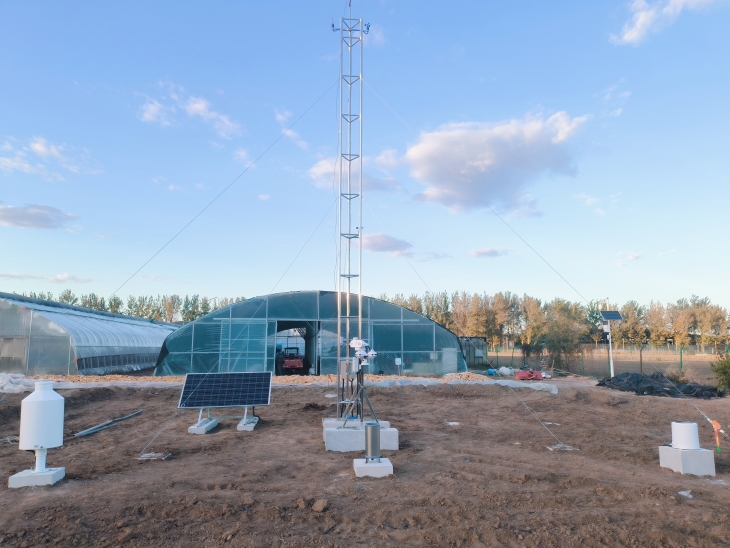
To ensure the comprehensiveness and accuracy of monitoring data, the high-standard farmland intelligent meteorological monitoring station is equipped with a “high-precision, multi-dimensional” monitoring system. It not only includes meteorological and environmental monitoring devices such as ambient temperature, humidity, and pressure sensors, wind speed and wind direction sensors, weighing-type rain and snow gauges, and evaporation sensors, but also features a multi-layer soil temperature and moisture sensor network, as well as solar radiation sensors for global radiation, direct radiation, reflected radiation, net radiation, and sunshine duration. All monitoring data are collected at a minute-level frequency and transmitted in real time, providing solid data support for the precise and intelligent transformation and upgrading of modern agriculture at the experimental station, and equipping agricultural production decision-making with an “intelligent brain.”
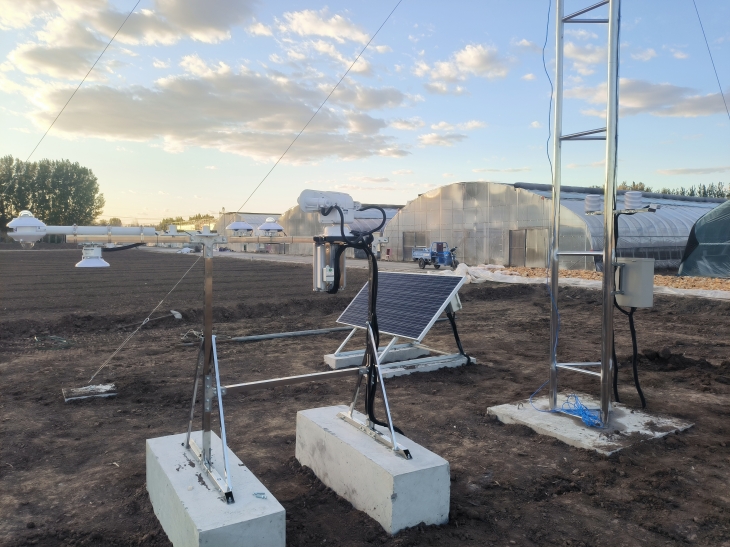
The Beijing Tongzhou Experimental Station of China Agricultural University mainly focuses on the research and application of cutting-edge agricultural technologies, and therefore has extremely high requirements for the timeliness, accuracy, and comprehensiveness of meteorological data. Sunshine Meteorological Technology’s high-standard farmland intelligent meteorological monitoring station precisely aligns with the monitoring needs of modern agriculture and has become a key solution to address the pain points of agricultural meteorological services:
Accurate temperature and humidity data help researchers screen crop varieties that are better adapted to local climatic conditions. The analysis of wind direction, wind speed, rainfall, and evaporation provides precise time windows for agricultural activities such as irrigation and fertilization, helping to reduce losses and increase efficiency in agricultural production.
The solar radiation sensors adopt advanced optical measurement technology. By detecting spectral characteristics from visible light to shortwave near-infrared bands, they obtain various vegetation indices, accurately reflecting crop water status, growth conditions, biomass, photosynthetic efficiency, and overall plant health.
Intelligent sensors are used to monitor temperature, humidity, water content, and water storage at different soil depths. The system can observe soil temperature and moisture across six soil layers, enabling real-time monitoring of soil volumetric water content and soil temperature. This supports refined soil moisture management, facilitates precision irrigation, and promotes water conservation in farmland.
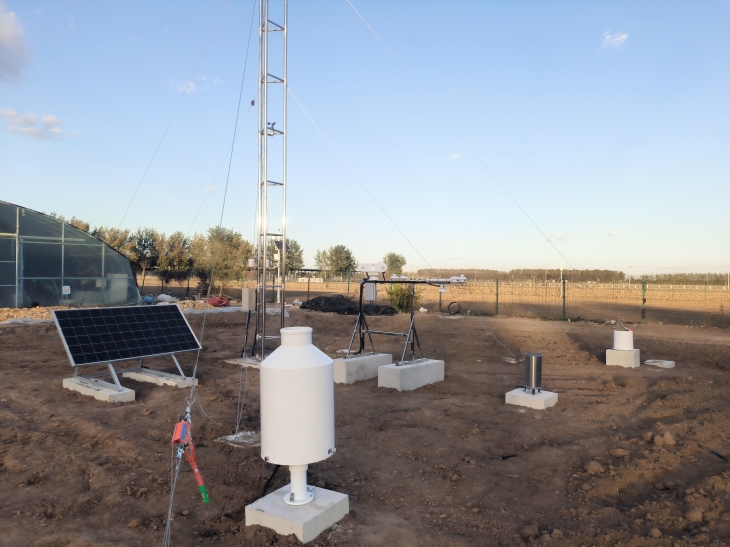
By deeply integrating Internet of Things (IoT) technology with big data analysis, the meteorological monitoring station sets the data acquisition frequency according to scientific research needs (e.g., once every 30 minutes), synchronously collecting both meteorological and soil moisture data, which are then uploaded to the experimental field’s scientific research monitoring platform via communication modules.
The platform supports real-time data visualization (curves and reports), historical data queries (filtered by time or parameters), data export (in CSV/Excel formats), and data quality assessment functions. It can identify and eliminate abnormal values to ensure data reliability and accuracy.
