
Powering Safer, Greener, Smarter Operations with Sun Weather
Recently, Sunshine Meteorological Technology installed a six-element regional automatic weather station for a company’s industrial park, which has now been put into operation. With its precise monitoring of multiple key meteorological indicators and real-time data support, the system provides “visualized management intelligence” for production operations, becoming an “intelligent hub” that safeguards employee safety and empowers production scheduling.
The six-element weather station is a high-precision automatic meteorological observation system developed by Sunshine Meteorological Technology for various industries. It integrates measurements of temperature, humidity, air pressure, wind speed, wind direction, and rainfall into one system. Featuring a modular design, it supports the expansion of additional measurement elements and can be optionally equipped with an AI intelligent real-time video terminal system. The station adopts fully digital sensor technology, supports solar power supply, and deeply integrates measurement performance with mechanical aesthetics. It can operate in temperatures ranging from -30°C to 70°C and relative humidity from 0% to 100%, making it highly suitable for outdoor monitoring environments.
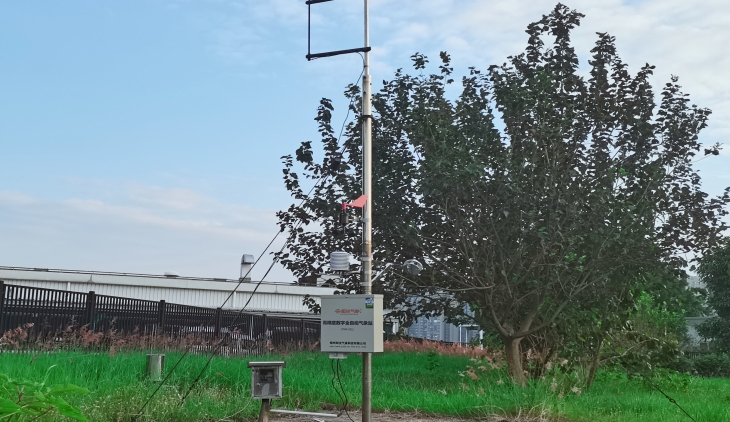
The weather station is equipped with a domestically developed, fully digital data logger independently designed by Sunshine Meteorological Technology. The data acquisition frequency can be set to 1 minute, 5 minutes, 10 minutes, or 1 hour according to user requirements. The built-in storage of the weather station can record up to 1 million sets of data. This large storage capacity reduces the cost of upgrading storage components. It integrates GNSS time synchronization with a timing error of 10–15 (ns), which not only improves the accuracy of time observation but also effectively reduces the complexity of program design and weather station operation while ensuring the security of meteorological data.
The weather station supports multiple communication interfaces, including RS232/485, USB Type-C virtual serial port, Ethernet, WiFi, and 4G/LoRa. It also supports mainstream wireless communication functions (Bluetooth, WiFi) as well as wired USB communication. The weather station adopts an advanced networked base station deployment model, enabling multi-point weather station networking and monitoring. Multiple weather stations can be interconnected, allowing headquarters to have real-time access to data from all sites.
